
Hosting a Teen Slumber Party: A Parent’s Guide to Getting It Right (Without Being the Fun Police)
There’s a big difference between planning a sleepover for a 10-year-old and planning one for a 13-, 14-, or 15-year-old — even if it doesn’t always feel that way when you’re the one stocking up on snacks and trying to figure out a reasonable bedtime.
With tweens, you were mostly managing logistics: sleeping bags, a movie, some popcorn, and a 10 pm lights-out that nobody really stuck to. With teens, the dynamic shifts. There’s more independence, more social complexity, more tech in every pocket, and a whole lot more potential for things to go sideways if expectations aren’t clear from the start.
Not ready to start planning yet? Save these ideas to Pinterest for later

The good news? A little thoughtful planning goes a long way. And when you involve your teen in that planning rather than handing down a list of rules, you’re setting everyone up for a night that’s actually fun — and a morning you can all look back on without cringing.
Here’s everything you need to know to host a teen sleepover that works for your family.
1. Have the Planning Chat Before Anyone’s Officially Invited
This is the step that makes everything else easier, and it’s one parents often skip in the excitement of saying yes to the event.
Before a single text goes out, sit down with your teen and talk it through — who they’re thinking of inviting, what they want the night to look like, and what the ground rules will be. Frame it as a collaboration, not a debrief. When your teen feels like they have input into the plan, they’re far more likely to actually hold to it when things get a little chaotic on the night.
This conversation is also where you can flag any concerns early — like if their idea of “a few people” and yours don’t quite match up.
2. Agree on Numbers — and Stick to Them
When it comes to teen sleepovers, more is not more. A larger group brings more energy, more noise, more mess, more variables, and — if things go wrong — more drama to untangle afterwards.
Think about your actual space. Can you comfortably fit six sleeping bags in your living room without it feeling like a chaotic overflow? Is your bathroom situation manageable for that many people in the morning? Are you okay with that level of activity in your home until 2 am?
Find a number that works for you, agree on it with your teen before invites go out, and be the kind of parent who holds that line kindly but firmly when the “can my friend also come?” texts start arriving the day before.
3. Know Who’s Coming — and Communicate With Their Parents
Ask your teen for a full guest list. Names, not just “my friends from school.” It’s not about being controlling — it’s about being a responsible host. And it’s completely reasonable to expect that the people who show up match the people who were invited, with no surprise tag-alongs arriving at 9 pm.
It’s also worth touching base with the parents of your teen’s guests, especially if it’s the first sleepover of this kind at your place. A quick message introducing yourself, sharing your address, and letting them know what the plan is goes a long way toward building mutual trust.
Use this moment to ask about any allergies, dietary needs, medications, or anything else you’d want to know as the host parent.
4. Send a Proper Invitation — Even If It’s Just a Message
Your teen is not mailing paper invites. That’s fine. But the spirit of a proper invitation still matters.
Whether it’s a group chat message, an Instagram DM, or a simple text, make sure the invite includes: the date and time (including pickup time the next morning), what to bring (sleeping bag, pillow, any personal toiletries), a note about any house rules guests should know upfront, and a way for parents to ask questions.
If your teen wants to make it feel more special — and some do — there are plenty of free digital invite templates that look great and take ten minutes to put together. Canva has loads of options that feel age-appropriate without tipping into “unicorn birthday party” territory.
5. Set Up a Space That Feels Like Theirs
One thing that hasn’t changed from the tween years: teens want to feel like the space is theirs for the night, not like they’re guests in your living room who need to keep the volume down.
The living room is usually the best setup — it’s bigger than a bedroom, easier for everyone to spread out, and it naturally separates the party from the rest of the house. Load it with extra blankets, pillows, and if you want to go the extra mile, set up a little snack station they can graze from throughout the night.
A few extra tips for making the space work:
- Have a spot for everyone’s bags and phone chargers so there’s no chaos hunting for cables at midnight
- Put some supplies nearby for spills (it will happen)
- If you have younger kids or early-rising family members, think about how to minimize the sound bleed into other parts of the house
6. Talk Through Co-ed Expectations If That’s the Plan
More teen sleepovers are mixed-gender these days, and that’s completely fine — but it does require a bit more upfront thought.
If your teen is planning a co-ed sleepover, have a direct, drama-free conversation about sleeping arrangements (who sleeps where), bathroom use (is there a schedule, or separate bathrooms?), and any parts of the house you’d prefer are off-limits overnight.
None of this needs to be a big deal if you address it early. The awkward scenarios only tend to happen when nobody thought to say anything ahead of time.
7. Be Clear About House Boundaries
Where can they be? Where can’t they be? What happens after a certain time?
These aren’t unreasonable questions — they’re just good hosting. If you don’t want a group of teenagers in the backyard at midnight, say so before the night starts. If the upstairs rooms are off-limits, let them know. If the garage, the basement, or any other space has specific rules attached to it, now’s the time.
You can frame this as a house tour — your teen showing their friends around when everyone arrives and naturally pointing out the layout, including the “we hang out here, not there” information.
8. Agree on a Wind-Down Time (Not a Bedtime — a Wind-Down Time)
Look, nobody’s going to sleep at 10 pm. That’s not how teen sleepovers work, and fighting it will just make you the enemy of the night.
But there’s a meaningful difference between “staying up talking until 1 am” and “still fully awake, running around, at 4 am.”
Agreeing on a rough wind-down window — where things get quieter, screens go to low volume, and the energy settles — is a reasonable thing to ask for, and most teens will accept it if it’s framed as “we’re not going to bother you, we just need things calmer after X time” rather than a hard lights-out order.
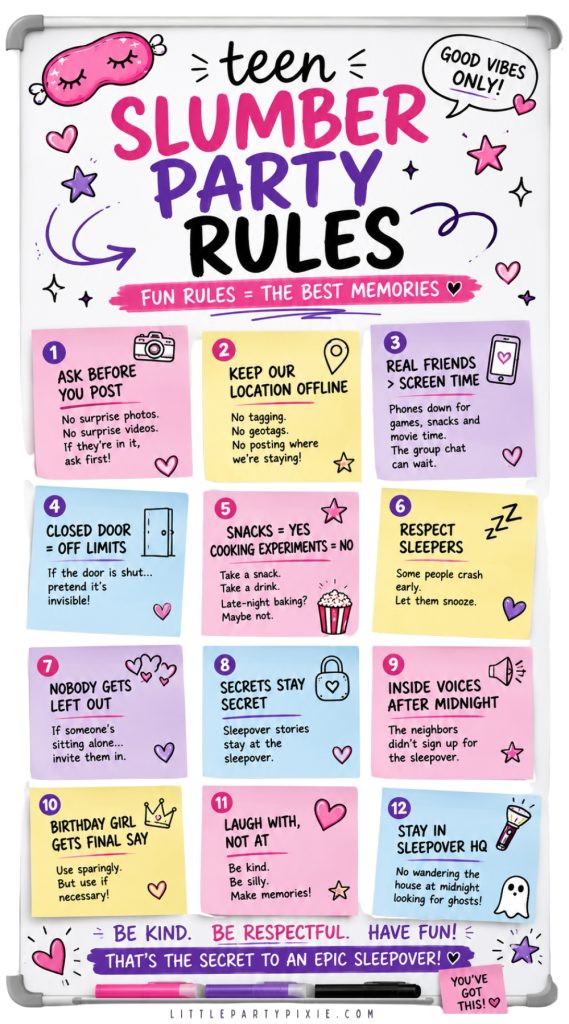
9. Have the Phone and Social Media Conversation Early
This is the one that’s changed everything about teen sleepovers compared to what we grew up with, and it deserves its own honest conversation before the night begins.
Specifically, think about addressing:
- Recording and posting. A no-filming-others-without-permission rule is worth stating clearly. Group videos and TikToks that seem hilarious in the moment can cause real friendship fallout — or genuine embarrassment — the next day. It’s not about being a killjoy; it’s about protecting everyone in the room, including your teen.
- What gets posted about your home. It’s reasonable to ask that guests don’t share your address, post your home’s interior, or tag your location on social media. You don’t have to be heavy-handed about it — just mention it casually as part of the setup.
- Phone-free time. This one’s optional, but some families find it works well: agree on a window — maybe one movie or one activity — where phones go in a basket, and everyone’s actually present together. Teens often enjoy this more than they expect to.
10. Plan Food That Won’t Stress You Out
Sleepovers are not the time to experiment with elaborate cooking. Keep it simple, keep it crowd-pleasing, and make sure you’ve checked for allergies and dietary needs before you shop.
The classics exist for a reason: pizza, popcorn, chips, dips, candy, fruit, and a good selection of drinks.
One crowd-pleasing activity that doubles as dinner? DIY pizza. Pick up some pre-made bases, set out bowls of toppings, and let everyone build their own. It’s hands-on, caters to picky eaters, is cheap, and takes about 15 minutes. Genuinely one of the best low-effort teen sleepover moves there is.
If you want to add something a little more special without too much effort, a DIY hot chocolate station — with toppings like marshmallows, sprinkles, and chocolate sauce — is always a hit.
Or try a sweet charcuterie board – aesthically pleasing and suprisingly easy to satisfy the midnight munchies!

It’s also worth having a few light breakfast options ready for the morning — bagels, pastries, cereal, fruit. Nothing fancy; just something so you’re not scrambling at 9 am.
11. Have a Few Activities Ready — But Don’t Over-Schedule
The goal isn’t to run a summer camp. Teens are perfectly capable of entertaining themselves, and honestly, most of the best sleepover memories come from the unplanned moments — the random conversations, the inside jokes, the tangent that becomes a two-hour thing.
That said, having a couple of ideas up your sleeve such as some ice breakers games means you’re covered if the group hits an awkward lull. Think: a movie or two, a card game, a trivia round, a baking project, or whatever feels right for your teen’s group.
For a deeper dive into what actually works for this age group, we’ve got dedicated guides to keep you covered:
- 👉 [Sleepover Activities for Teen Girls] — from DIY spa nights to creative challenges
- 👉 [Sleepover Activities for Teen Boys] — from gaming setups to outdoor challenges
If you’re after a little more structure, make sure you check out our Slumber Party Games Bundle – ideally suited to girls approximately 8-15 years old, we have 25+ printable games that you can download in flash if you’re looking for some quick party entertainment!
12. Your Role on the Night: Present, Not Hovering
Here’s the thing nobody tells you: the best-hosted teen sleepovers are the ones where the parent is quietly there without being visibly in it.
Pop in with snacks. Do a casual “just checking in” pass at some point during the evening. Make yourself available if something goes wrong. But beyond that, trust your teen to host their friends — because that’s exactly what they’re doing.
One thing from our tween sleepover playbook that absolutely carries over to teens: the safe word.
Before the party starts, agree on a word or phrase with your teen that they can work naturally into conversation if they need you to step in — if things are getting out of hand, someone’s making them uncomfortable, or they just want a graceful exit from a situation.
Something innocent like “Mom, did you get more of that orange juice?” is all they need. You can appear, redirect, and problem-solve without anyone else knowing a thing.
It sounds small, but it gives your teen real confidence going into the night — knowing you’re a resource, not a threat.
13. Have a Plan for When Things Don’t Go to Plan
Even beautifully organized sleepovers hit a bump occasionally. Someone gets homesick. Two friends fall out over something small. Someone just isn’t feeling it and wants to go home.
Let your teen know ahead of time that any of these things can happen, and that it’s genuinely okay if they do. If a guest needs to leave early, you’ll help sort it without drama. If something feels off, they can come to you.
Normalizing the “it’s okay to need something” conversation before the night means your teen is far less likely to feel stranded if something comes up.
It’s also worth thinking through the basic “what-ifs” with your teen: What if there’s a power cut? What if a guest doesn’t feel well? What if something escalates between friends? None of this needs to be a big serious meeting — just a five-minute “here’s what we’d do if…” chat that leaves everyone feeling prepared.
14. The Morning After: Don’t Let It Be an Afterthought
This is the bit that catches a lot of parents off guard. The sleepover is over! But the job isn’t quite done.
Make sure parents know the pickup time — and ideally confirm it the morning of. Have something simple ready for breakfast so the morning feels welcoming rather than like you’re counting down to the door closing behind the last guest.
And yes, your teen absolutely can — and should — help with the cleanup afterwards. That’s part of being a host, and it’s a completely reasonable expectation.
A Note on the Packing List
Want to make sure your guests (and your own teen) show up prepared? We’ve got a full Slumber Party Packing Checklist that covers everything from the obvious (sleeping bag, change of clothes) to the stuff people always forget (phone charger, face wash, a second pair of socks).

It’s worth sharing this, both when the invites go out and the day before the big night in a group chat – with teens and respective parents!
Regardless: always stock up on extra blankets and pillows, spare phone chargers and some basic medicines and toiletries.
The Bottom Line
Hosting a teen sleepover isn’t about having perfect control over the night — it’s about setting up the right conditions and then getting out of the way.
When your teen feels like a real co-planner, when the ground rules are clear before anyone arrives, and when they know you’re available without being overbearing, something good tends to happen: they actually rise to the occasion. They host well. They manage their friends. They handle the small dramas without needing you to step in.
And honestly? That’s the whole point. Every sleepover is a small practice run in independence, responsibility, and knowing how to have fun without things falling apart.
That’s worth a little lost sleep.
© Little Party Pixie 2026