18 Halloween Games for Teens That Actually Feel Cool (Not Cringe)
Teen Halloween games live or die on one thing: does it feel like something they’d actually choose to do, or does it feel like a game their mom picked?
The difference usually comes down to specifics — vague “party games” ideas read as childish, but a proper Horror Movie Trivia round with visual clues, or a Mafia game with a Halloween twist, reads as genuinely fun regardless of age.
Not ready to play yet? Save these ideas to Pinteret for later
Below are 18 unique games organized by type, each with what it actually involves, what you need to pull it off, and how much effort you’re signing up for.
A note on difficulty: we’re rating each one Low, Medium, or High effort — this is about setup and hosting complexity, not how fun it is. Some of the lowest-effort games on this list are also the most popular.
Looking for the full party plan, not just the games? We cover everything else — timing, food, movies, and hosting logistics — in our teen Halloween party guide.
Story & Social Deduction Games
These are the ones that carry a whole night on their own — minimal props, maximum engagement, and they lean into the fact that teens are genuinely good at reading each other.
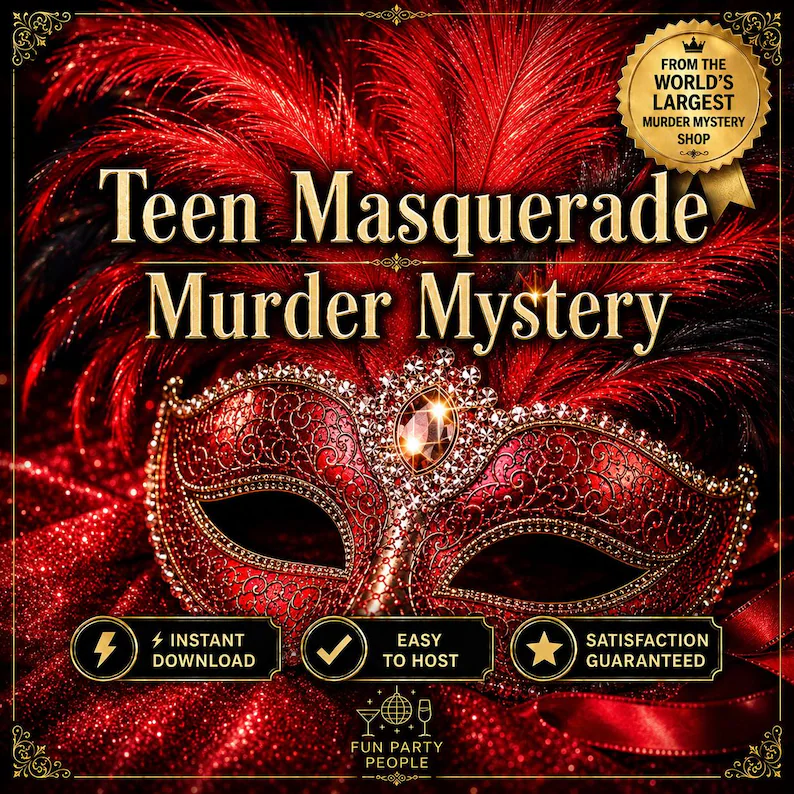
1. Murder Mystery Party
What it involves: Everyone’s assigned a character with a backstory and motive ahead of time. Guests stay in character all night, trading information and gathering clues to piece together who committed the fictional murder.
There’s no single “winner” in the traditional sense — it’s collaborative solving — but most kits build in a moment where whoever correctly names the killer gets the bragging rights (and it’s genuinely satisfying when someone nails it). Works best woven into whatever theme you’ve already picked.
- Materials: A pre-written murder mystery kit (plenty of printable ones exist online), character name cards, optional simple costume elements per character.
- Effort: High — this needs to be planned in advance, not improvised on the night.


2. Halloween Mafia (or Werewolf)
What it involves: A classic social deduction game reskinned for Halloween — “werewolves” secretly eliminate “villagers” each round while everyone else tries to figure out who’s lying before it’s too late.
This one has a clear win condition, which is part of the appeal: villagers win by voting out every werewolf; werewolves win by outnumbering the villagers.
It’s built for replay — most groups run four or five rounds in a night, rotating who plays which role, and a small prize for whoever “survives” the most rounds adds a nice competitive edge.
- Materials: A deck of role cards or just an app — nothing physical required at all.
- Effort: Low — read the rules once, and you can run it cold.
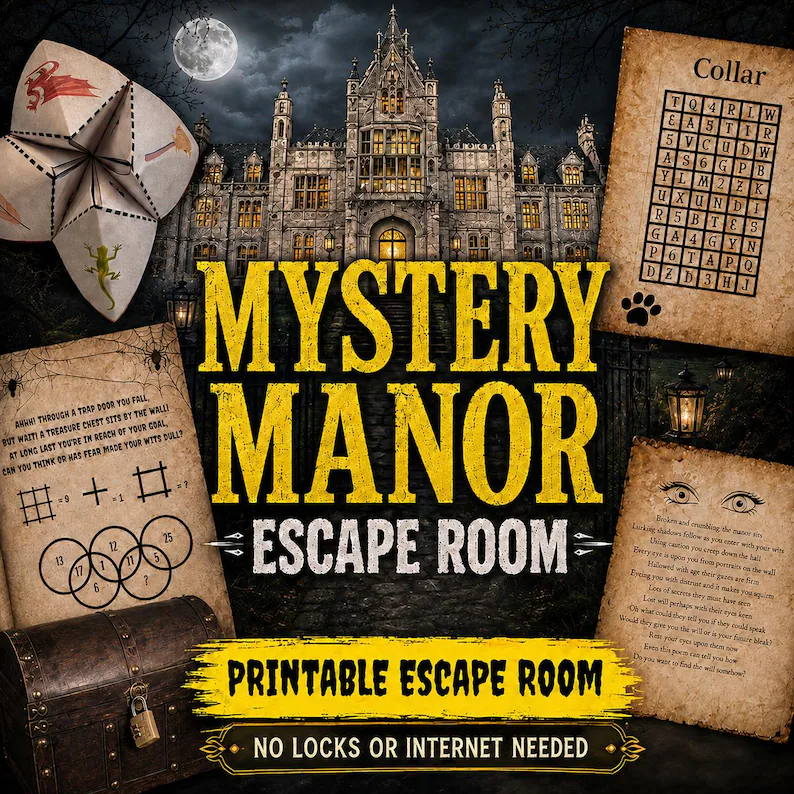
3. Escape Room Challenge
What it involves: Turn a room (or the whole house) into a puzzle to solve — locks, riddles, and hidden clues that build toward a final “escape.” Split into teams and time each group; the fastest team out wins, and everyone else still gets the satisfaction of finishing even if they’re not first.
The prize goes to the winning team, but honestly most groups end up more invested in beating their own time than beating each other.
- Materials: Combination locks, printed riddles/clues, small props to hide clues in, a timer.
- Effort: High — this is the most labor-intensive game on the list to build, but it’s usually the one people talk about after.


4. DIY Séance Storytelling Circle
What it involves: Lights off, one flashlight under the chin, and a rotating ghost story circle — but give it structure with a prompt jar so nobody’s stuck freestyling a scary story on the spot.
There’s no winner here by design; it’s atmosphere and bonding, not competition. If you want a little extra fun, take an anonymous vote afterwards for “creepiest story” and let that person keep the flashlight as a joke trophy.
- Materials: A flashlight, a jar of story-starter prompts, optional atmospheric sound (a phone playing ambient wind/creak sounds works fine).
- Effort: Low — zero setup beyond writing a handful of prompts in advance.
Trivia & Performance Games
The ones that get loud, competitive, and a little ridiculous — good for when the energy needs a jolt.
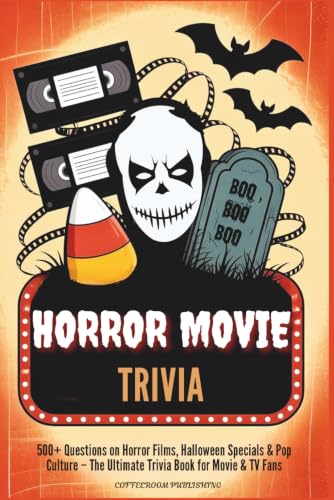
5. Horror Movie Trivia
What it involves: Questions ranging from easy to genuinely hard about horror films, ideally with a visual round (movie stills) and an audio round (iconic sound clips) to break up straight Q&A.
Play in teams or individually, keep a running scoreboard, and give a real prize to whoever’s on top at the end — this one benefits from actual stakes, since a points-based game with nothing on the line tends to lose steam by round three.
- Materials: A prepared question list, a way to play clips (phone/speaker), scorecards.
- Effort: Medium — writing good questions takes some prep (or purchase a pre-made question set), but running it is easy.


6. Horror Movie Charades
What it involves: Same as classic charades, but every prompt is a horror movie title, scene, or iconic moment — surprisingly harder (and funnier) than it sounds once someone’s silently acting out a jump scare.
Play team versus team, award a point per correct guess within the time limit, and whichever team hits a set point total first wins. Purely for laughs otherwise — a small prize is a nice touch but not necessary.
- Materials: A list of movie titles/scenes on slips of paper, a timer.
- Effort: Low — five minutes to write the prompt list and you’re ready.
7. Horror Movie Lip Sync Battle
What it involves: Teams or individuals lip sync to iconic horror movie lines, theme songs, or trailer voiceovers — genuinely funny to watch and easy to film for the group chat afterwards.
This one’s judged by audience reaction rather than points: the loudest cheer wins, judged American Idol–style. Works best as a mid-party energy spike rather than the whole night’s activity.
- Materials: A phone with the audio clips queued up, optional ring light for the “performance” feel.
- Effort: Low — the fun is in the performance, not the production.
8. Halloween Would You Rather: Extreme Edition
What it involves: A fast-paced icebreaker with genuinely tough, Halloween-themed dilemmas — good for a lull in the night or as a warm-up before something bigger.
No winner, no prize — it’s a conversation starter, though you can gamify it lightly by tallying which answer the group picks most and seeing if anyone’s consistently in the minority.
- Materials: None beyond a written or printed list of questions (or steal our ideas here!).
- Effort: Low — this is the easiest game on the entire list to run.
Competitive & Physical Games
For when everyone needs to move, not just sit and talk.
9. Costume Contest With Real Categories
What it involves: Skip “best costume” as the only prize — run several categories (Most Creative, Best Group Costume, Most Likely to Actually Scare Someone, Best Use of Makeup) so more people walk away with a win instead of one person taking the only trophy.
Vote by paper ballot or show of hands, and announce winners per category rather than all at once for a bit more drama.
- Materials: Small prizes or bragging-rights certificates, a simple voting system (paper ballots or a show of hands).
- Effort: Low — the “work” is already done by everyone’s costumes.
10. Pumpkin Carving Competition
What it involves: Elevate it beyond a basic knife-and-marker setup — proper carving tools, stencils for intricate designs, and judged categories (Scariest, Funniest, Most Detailed) rather than one overall winner.
Judge by group vote at the end of the night once the pumpkins are lit up — it’s a nice way to close out the evening with everyone gathered around.
- Materials: Pumpkins, real carving tool kits, stencils, a well-covered table (this gets messy).
- Effort: Medium — mainly the cleanup, not the setup.
11. Zombie Tag (Flashlight Edition)
What it involves: A nighttime, outdoor twist on tag — one “zombie” starts, and anyone tagged joins the horde until one final survivor is left standing.
Purely elimination-style with a clear winner (last person untagged), which is exactly what gives it the competitive edge that makes teens actually want to play tag. Works especially well with a Zombie Apocalypse Halloween party theme.
- Materials: A dark outdoor space, flashlights, clear boundaries set in advance.
- Effort: Low — no props beyond flashlights, but needs a safe, clear space to run in.
12. Spooky Scavenger Hunt (Teen Level)
What it involves: The same bones as a kids’ scavenger hunt, leveled up — trickier riddles, photo challenge tasks, and a prize worth the actual effort of solving them. Run it team versus team with a shared finish line (a hidden “treasure” or final prize location); first team there wins, but build in enough clues that everyone’s still working toward the end even if they’re not first. We have a kids’ version you can build on here.
- Materials: Hidden items/clues, a written riddle trail, camera-ready photo challenge prompts.
- Effort: Medium — most of the work is in planning the trail beforehand.
Mystical & Sensory Games
The ones that lean into atmosphere as much as gameplay — great for building mood between the bigger activities.
13. Tarot & Fortune Telling Station
What it involves: A dedicated corner with a tarot deck (or a simple fortune-teller printable if nobody knows real tarot) where guests take turns getting a dramatic, tongue-in-cheek “reading.” No winner, no competition — this is pure atmosphere, and it doubles as one of the best photo moments of the whole night if you light the corner well.
- Materials: A tarot deck or printable fortune cards, a small table, moody lighting (a single candle or string lights).
- Effort: Low — set it up once and it runs itself all night.
14. Ghost Hunting Challenge
What it involves: Lean into the genuine teen fascination with ghost-hunting content — use an EMF meter app (several free ones exist) to “investigate” different rooms or the yard, with planted “hot spots” for dramatic effect.
Frame it as a team challenge: whichever group finds all the planted hot spots first wins, or keep it purely experiential with no formal winner if you’d rather it stay mood-focused than competitive.
- Materials: A smartphone with an EMF-style app, flashlights, a simple map of “investigation zones.”
- Effort: Medium — the app does the heavy lifting, but planting convincing hot spots takes some planning.
15. Blindfolded Mystery Taste Test
What it involves: Classic “guess what you’re touching/eating” game with a spooky rebrand — peeled grapes as “eyeballs,” cold spaghetti as “brains,” and so on.
Play it two ways: purely for laughs with no stakes, or as an elimination game where a wrong guess means you’re out, last person standing wins. Either version is a hit; the elimination version just adds a bit more tension.
- Materials: Blindfolds, small bowls of texture-appropriate foods, spoons.
- Effort: Low — most ingredients are things you already have or can grab cheaply.
16. Truth or Dare: Halloween Edition
What it involves: Age-appropriate but Halloween-themed — dares like “do your best horror movie scream” or “tell us your weirdest supernatural experience” instead of generic prompts. No winner here, purely a conversation and bonding game that runs as long as the group wants it to.
- Materials: None required, though a written prompt list keeps it moving if the group stalls.
- Effort: Low — zero setup, purely a conversation game.
17. Spin the Wheel: Dare or Confess
What it involves: A Halloween-themed spin on the classic — land on “dare” for a task, or “confess” for a lighthearted prompt (favorite horror movie, most embarrassing costume ever worn).
No formal winner; it’s designed to keep rotating and pull quieter guests into the fun without singling anyone out too hard. Keeps things playful without leaning romantic.
- Materials: A simple spinner (printable or improvised with a bottle and a paper wheel), a prompt list.
- Effort: Low — five minutes to make the spinner.
18. Minute to Win It: Halloween Edition
What it involves: Quick, silly, one-minute challenges using household objects with a Halloween twist — think candy corn balanced on a spoon, or stacking plastic pumpkins blindfolded.
Each round has its own winner (fastest or most successful completion), and most groups run several rounds as a mini elimination bracket. There are enough good ones to warrant their own full guide, which we’re building separately.
- Materials: Varies by challenge — most use everyday household items.
- Effort: Varies — flagged here as a teaser, full breakdown coming in its own piece.
The games everyone’s still talking about at school on Monday
You don’t need all eighteen of these in one night — pick two or three from different categories and let the group’s energy decide when it’s time to move to the next one. The ones that get replayed at every party after this one are usually the simplest to set up, not the most elaborate, so don’t feel like the escape room or the murder mystery is the “real” way to host. Sometimes it’s just Mafia and a good flashlight.
Want the rest of the party sorted too? Head back to our full teen Halloween party guide for themes, food, timing, and hosting logistics.

We also have a ton of suggestions for the best teen Halloween costumes perfect for groups, and loads more costume ideas – find it all in the Little Party Pixie Halloween Hub!
© Little Party Pixie 2026